Indicators last update: 9th September 2026
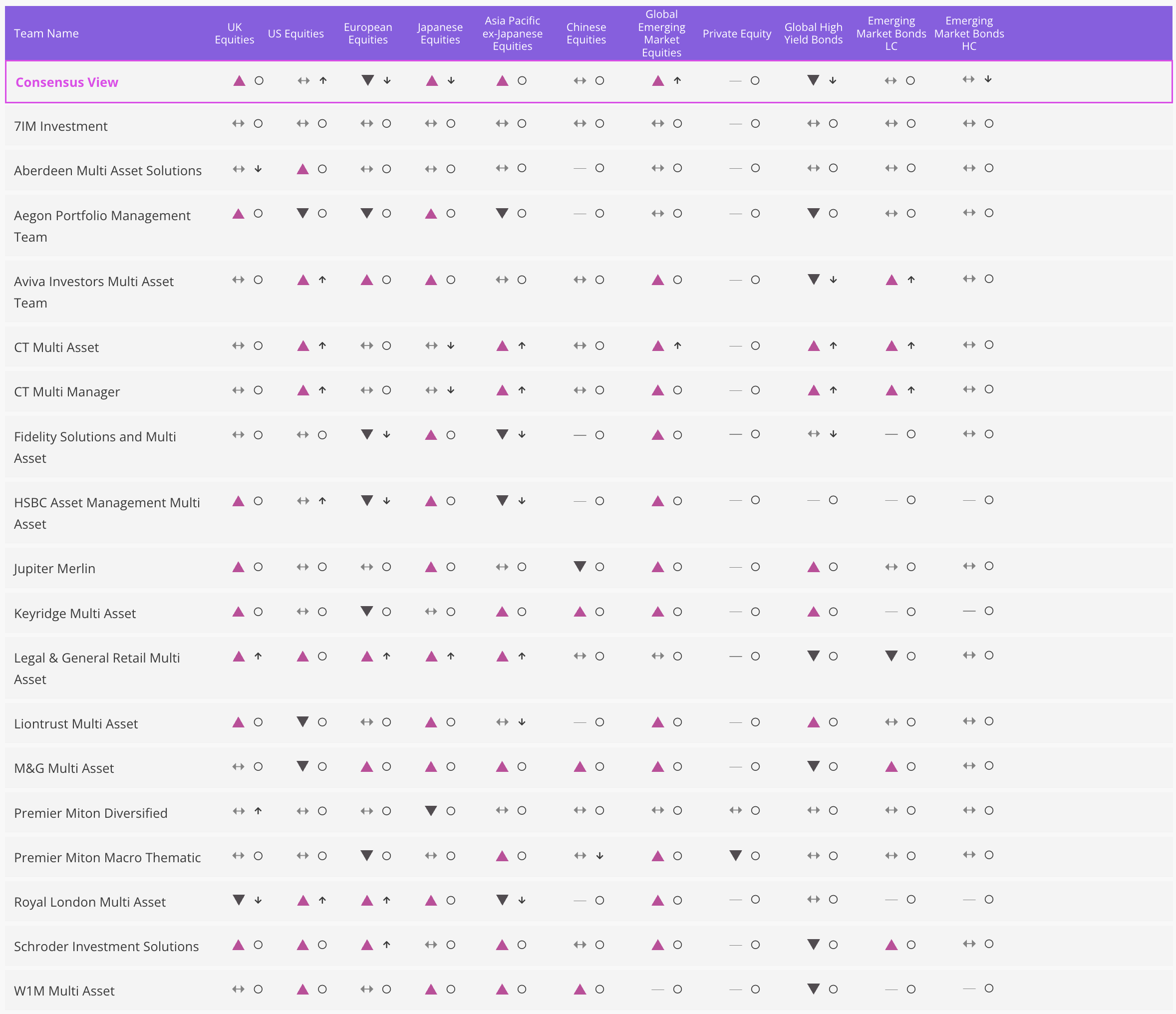
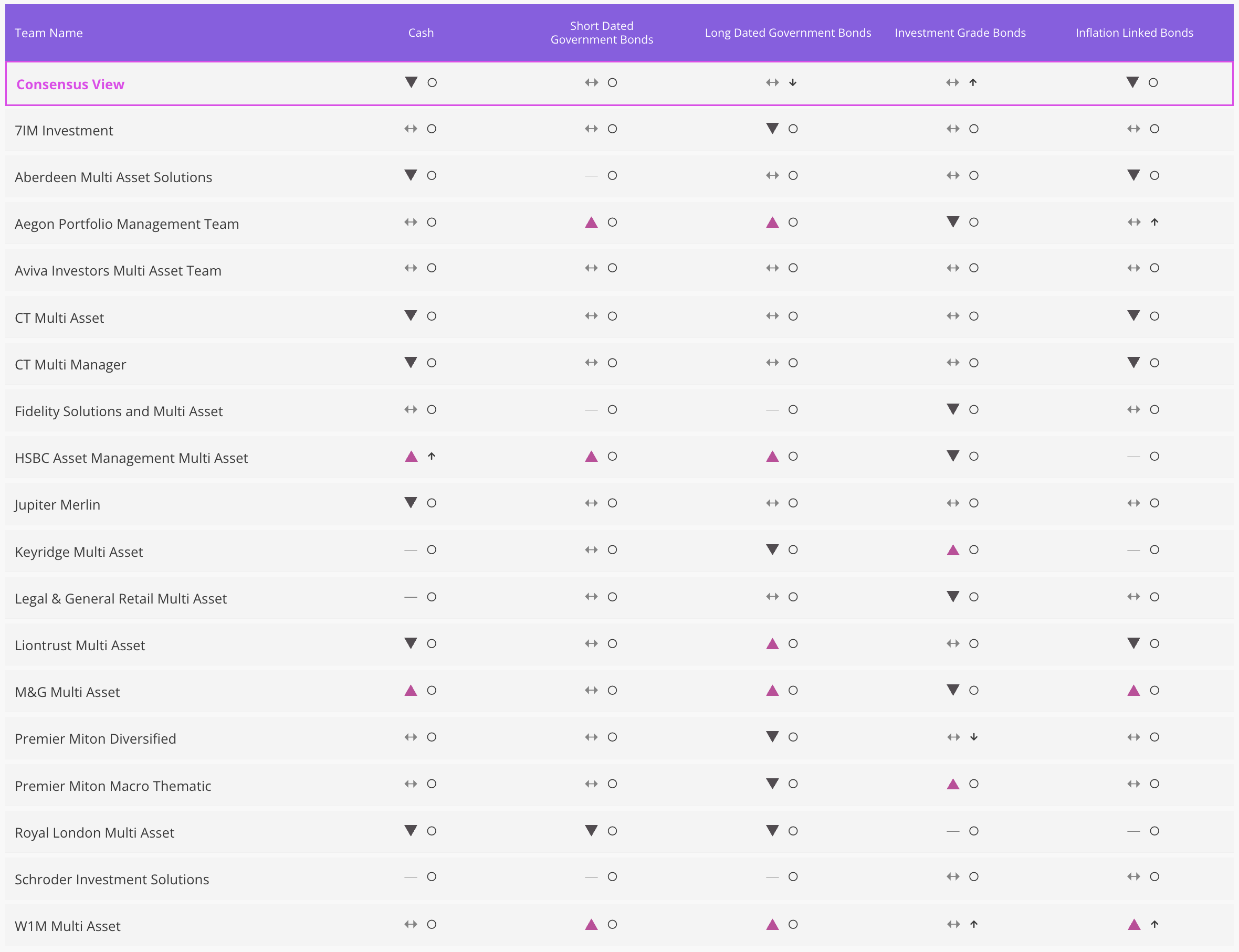
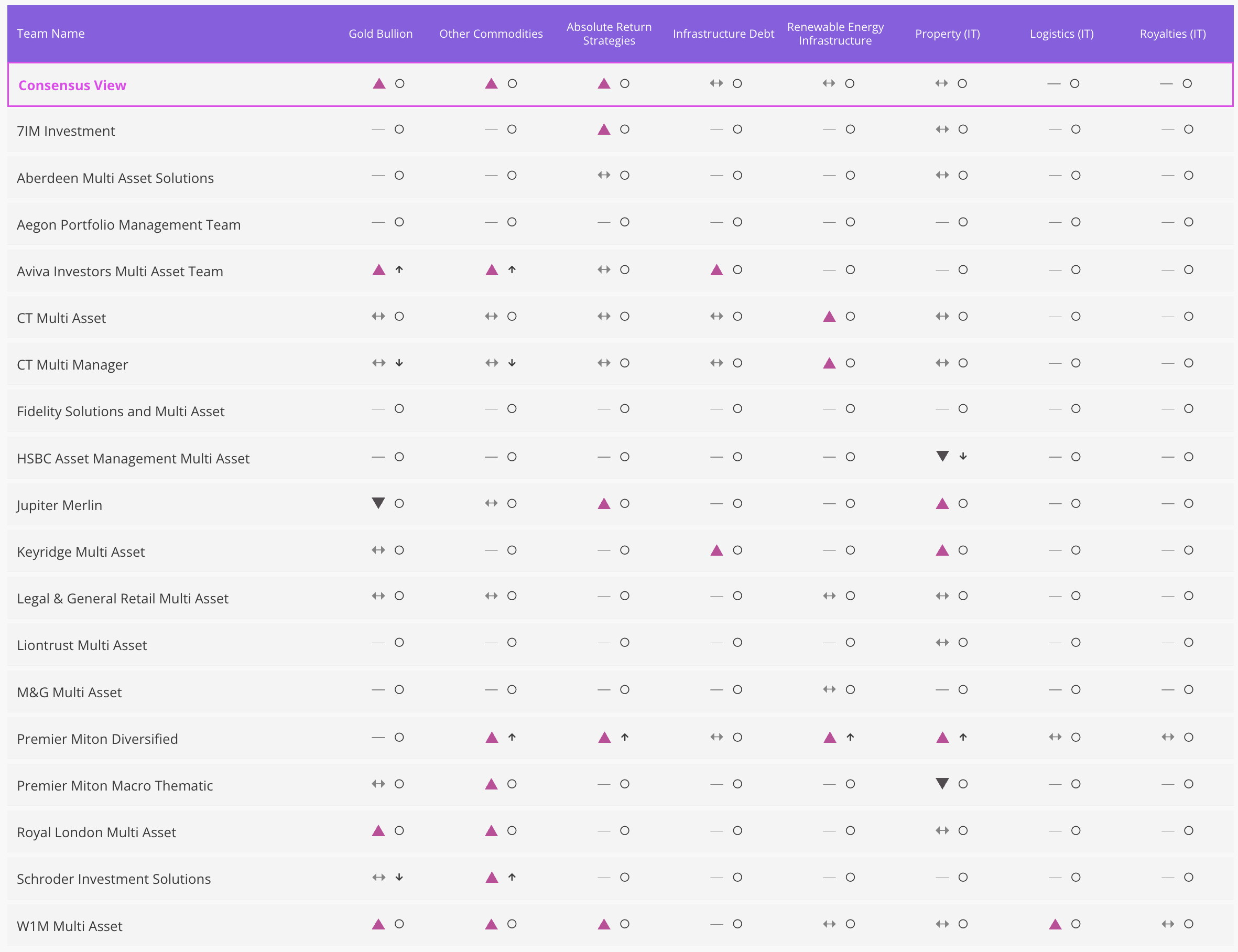
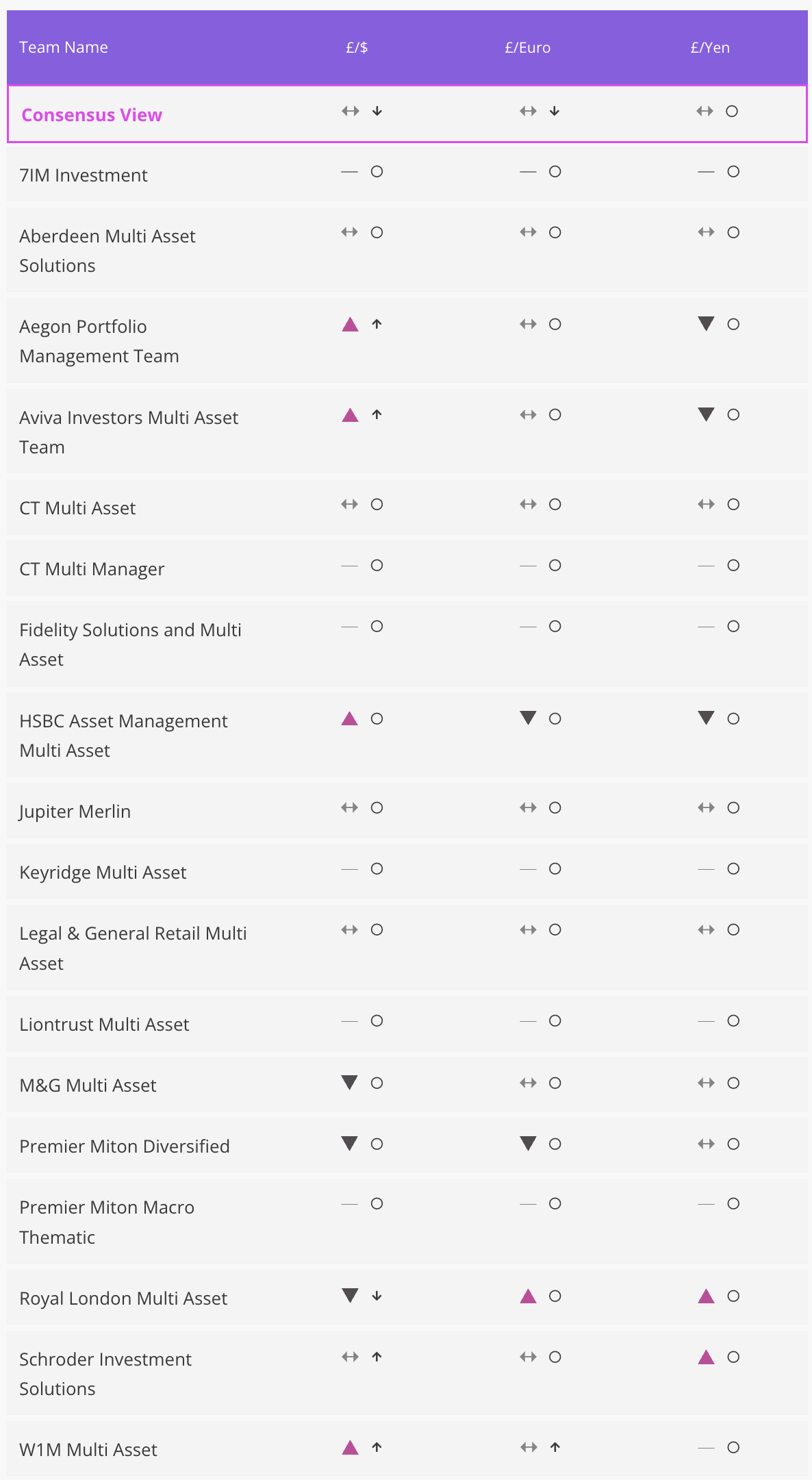
Our sentiment indicator shows the current direction of sentiment towards a broad range of asset classes as expressed by some of the UK’s leading multi asset teams. The first column for each asset class shows the multi asset teams’ current sentiments, and the second column shows how these have changed from the previous quarter. The tables below are updated quarterly.
Positive
The manager expects a positive return from the asset class over the next 12 month period.
Negative
The manager expects a negative return from the asset class over the next 12 month period.
Neutral
The manager is neither positive or negative about the prospects of the asset class over the next 12 month period.
No View
The manager currently has no view.
The manager has become more positive on the asset class since the last calendar quarter.
The manager has become more negative on the asset class since the last calendar quarter.
The manager’s view on the asset class hasn’t changed since the last calendar quarter.
For a guide to the symbols in the below table, please see the key.
For Q3 2026
Positivity abounds when it comes to sentiment towards equity markets in this quarter’s indicator. This is despite the many unresolved negative factors that have worried multi asset investors for some time – including the imposition of tariffs, trade disputes, higher inflationary pressures owing to the wars in Ukraine and the Strait of Hormuz, as well as concerns about the size of government debt piles and the extent to which demand for government debt might be impacted by investors preferring to lend to the giant AI hyperscalers. For now, however, it’s earnings growth that many multi asset investors are concentrating on, and this continues to be strong.
In the meantime, like the rest of us, multi asset investors are still straining to understand where AI will eventually take us, and who the likely winners and losers from it will be.
Sentiment wise, whilst multi asset investors remain mindful of current trade and geopolitical tensions, and in some cases the inherent stock concentration risks, global emerging markets continue to have the strongest support of any asset class in this quarter’s indicator results. Attractive valuations, improving fundamentals, and exposure to long-term growth areas such as technology, semiconductors, and AI, are all attracting interest. This positivity is being backed by multi asset investors seeing stronger earnings momentum.
Multi asset investors point to UK companies trading at meaningful discounts to their global peers. This has already resulted in a number of companies being acquired by overseas competitors and / or by private equity funds at a significant premium to their prevailing share prices. Share buy-backs are also on the rise. Healthy dividends supported by strong balance sheets and a pick-up in earnings growth expectations, is adding to the appeal for UK companies.
Multi asset investors point to a mix of structural demand, inflation protection, and selective supply-side support for some commodity segments. For example, when looking at the energy complex, even if the situation in the Strait of Hormuz becomes normalised, the price of oil should still find some strategic support from countries looking to rebuild their reserves. Elsewhere, industrial metals constitute another area of optimism, where copper is expected to benefit from a backdrop of resilient global growth, infrastructure spending, electrification, grid investment, and AI-driven capital expenditure.
In the meantime, physical gold is still widely held, although position sizes now tend to be below what they were at the end of last year – having been trimmed into the New Year after a very strong run.
For a number of quarters now, a widely held view amongst multi asset investors has been that investment grade bond spreads (the extra yield available when compared to the yield from government bonds that have broadly equivalent duration profiles) are not sufficient to compensate investors for the extra level of risk involved (credit risk). Some multi asset investors cite that the large-scale bond issuance by a number of giant tech businesses looking to fund expensive AI projects is also prompting them to steer clear.
In the meantime, although the interest rates available from cash are higher than in the not-so-distant past, most multi asset investors prefer government bonds as a ‘relatively’ safe haven alternative.
Sentiment towards European equites is balanced – with the positives of higher government spending on defence and infrastructure on the one hand, being offset by a combination of lacklustre economic growth and greater sensitivity to high energy prices than in other regions, on the other.
Interest in Chinese equities also remains rather subdued. Whilst the Chinese market offers exposure to technology companies on substantially cheaper valuation levels than their US equivalents, political concerns are making multi asset investors wary – with most preferring to get exposure to Asian technology by investing in companies in Japan, Korea, and Taiwan.
Multi asset investors are becoming more discerning over where to get their government bond exposure. As ever, views on likely central bank responses to inflationary pressures (hike rates or wait and see), the direction of economic growth, and in some cases, political uncertainty, are all playing their part. In addition, there are mounting concerns over the size of government deficits and the willingness, or lack of, to deal with them. Some are attracted by being able to lock-in to the higher yields now available from longer dated government bonds (although they will be more sensitive to higher levels of inflation if that comes about), whilst others prefer to offset the more growthy (and more interest rate sensitive) exposure within their equity books by investing in shorter dated government bonds.
Despite their elevated valuations and investors’ concerns around market concentration risk, US equities still saw the sharpest increase in positive sentiment of any asset class in this quarter’s indicator. The more valuation conscious multi asset teams might contest this when eying the biggest US companies, but as we note below, farther down the capitalisation scale they are still finding opportunities.
Strong momentum, exceptionally strong earnings growth, and attractive pockets of opportunity outside of the mega-cap leaders, are all cited as being supportive. With the War in Iran seemingly locked in stalemate, the domestic US economy appears largely unaffected – propelled by big spending on AI. Several managers point to earnings growth broadening out to include healthcare, utilities and smaller companies. Some in the passive space are expressing this view by investing in equal weighted index products.
In the meantime, local currency emerging market bonds continue to be seen positively – with multi asset investors citing their attractive yields, undervalued currencies (with the potential for them to appreciate and therefore provide greater upside), and lower attaching political risks than in years gone by. It’s interesting to note that outside of this sentiment indicator, all of these factors have been spoken about during many of our most recent face to face performance reviews with multi asset teams.
Changes to a more negative stance are in very short supply this quarter and we could have made a very good case for placing the assets in this section into the neutral sentiment category.
South Korean equities are noteworthy, however. June saw the start of a substantial decline in the share prices of a small clutch of individual semiconductor and memory names that had, up until then, propelled the South Korea stock market to historic highs. Concerns about overcrowding, speculative inflows from retail investors – some of whom were investing in leveraged single-stock ETFs – as well as market concentration and valuation risks, then led some multi asset investors to reduce their holdings.
These comments reflect the interpretation by Scopic Research of the results from its latest quarterly multi asset teams’ sentiment indicator. They are in no way meant to confer investment advice. The information contained was correct at the time it was received, but investment sentiment can change rapidly – even on a one-year view. Past performance isn’t a guarantee of the returns that might be achieved in the future, and investment returns can be negative as well as positive. www.scopicresearch.co.uk