Indicators last update: 12th June 2026
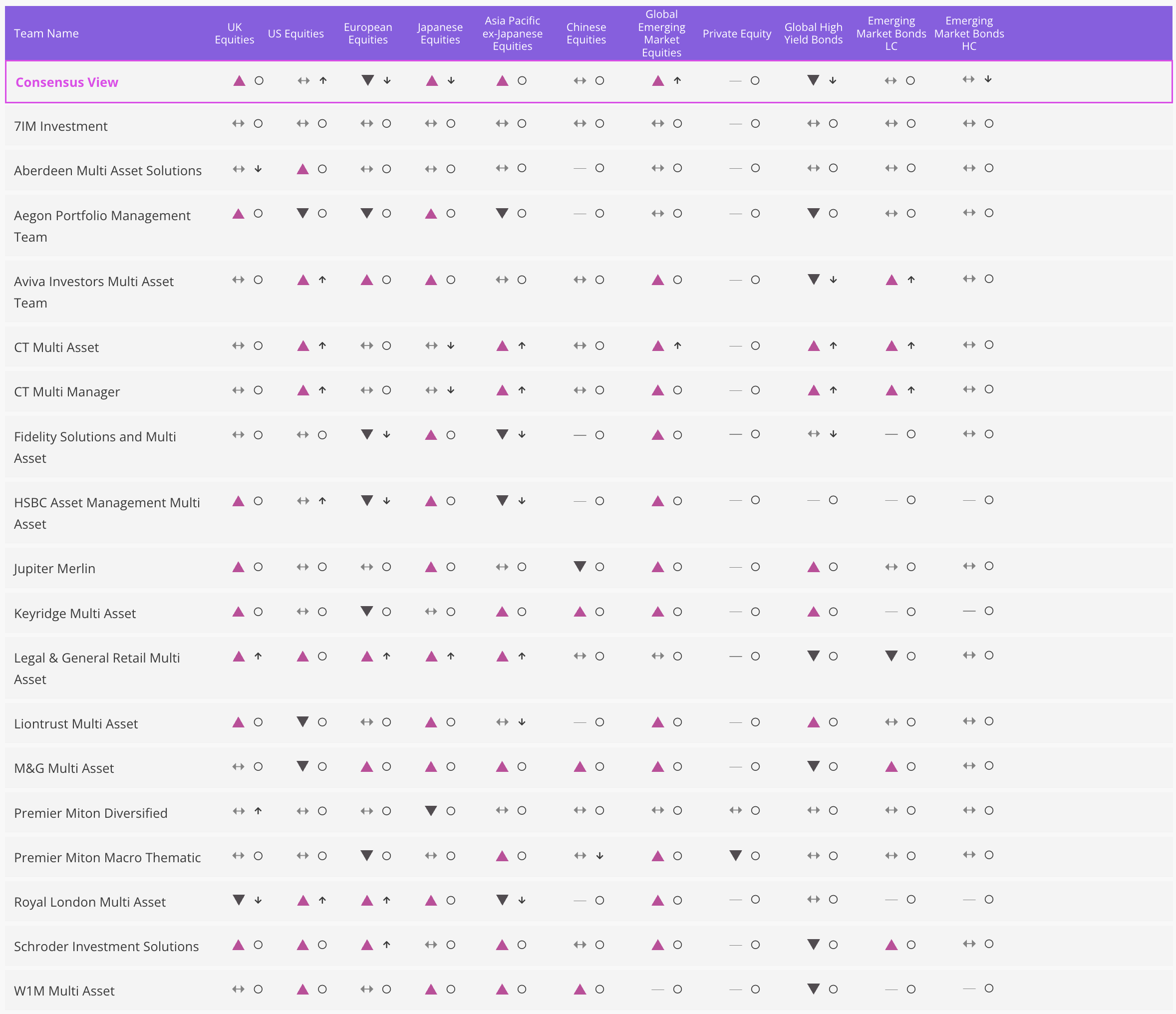
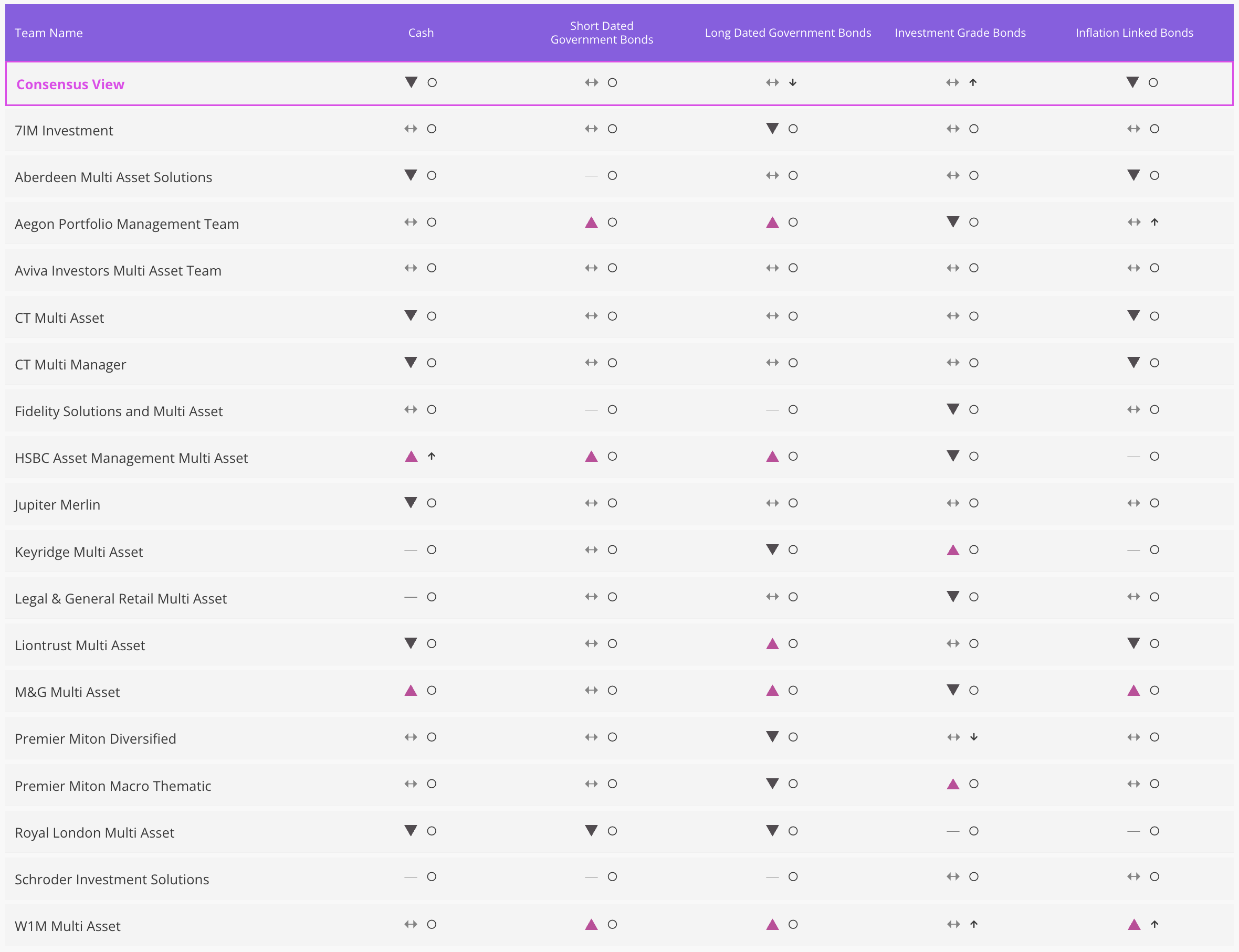
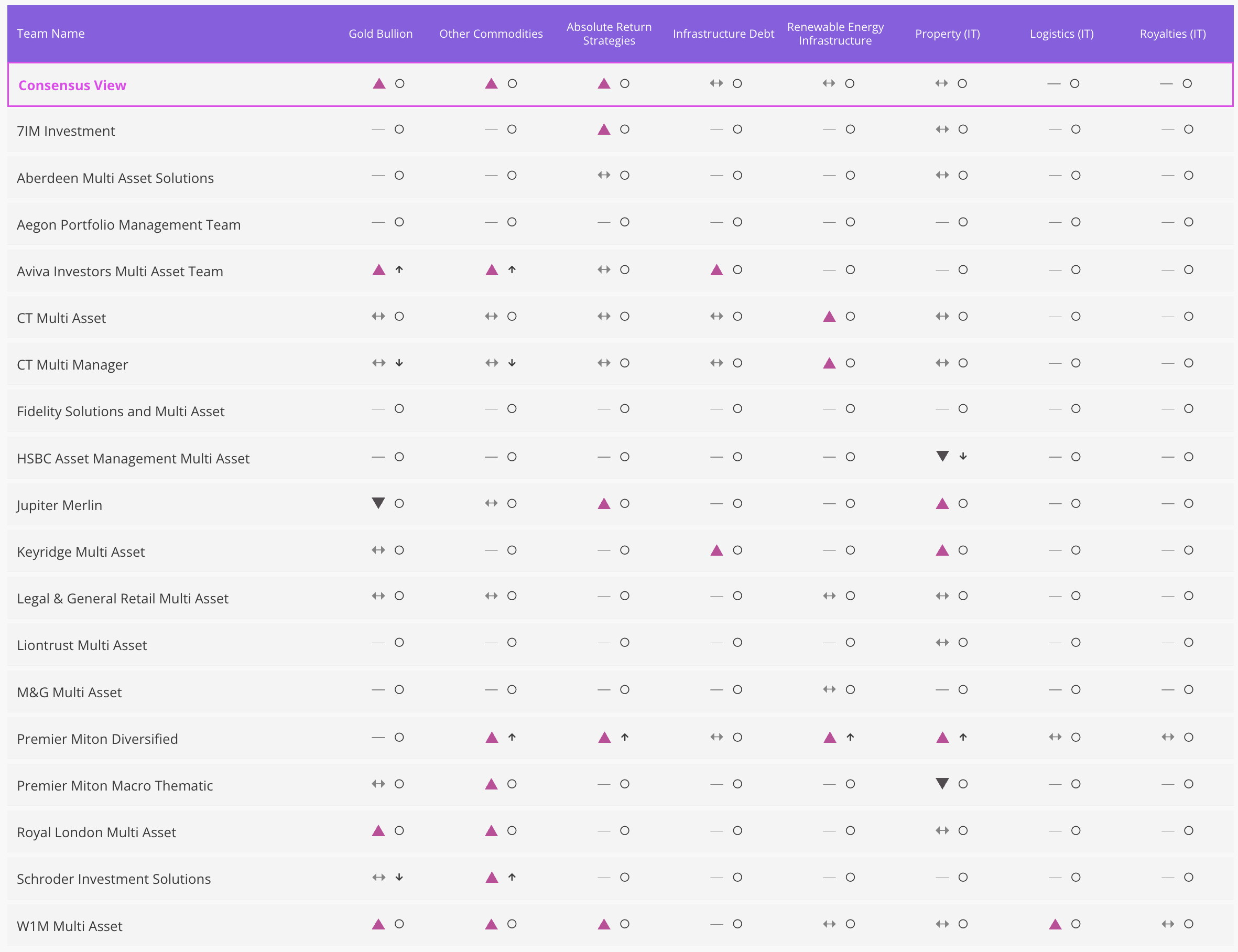
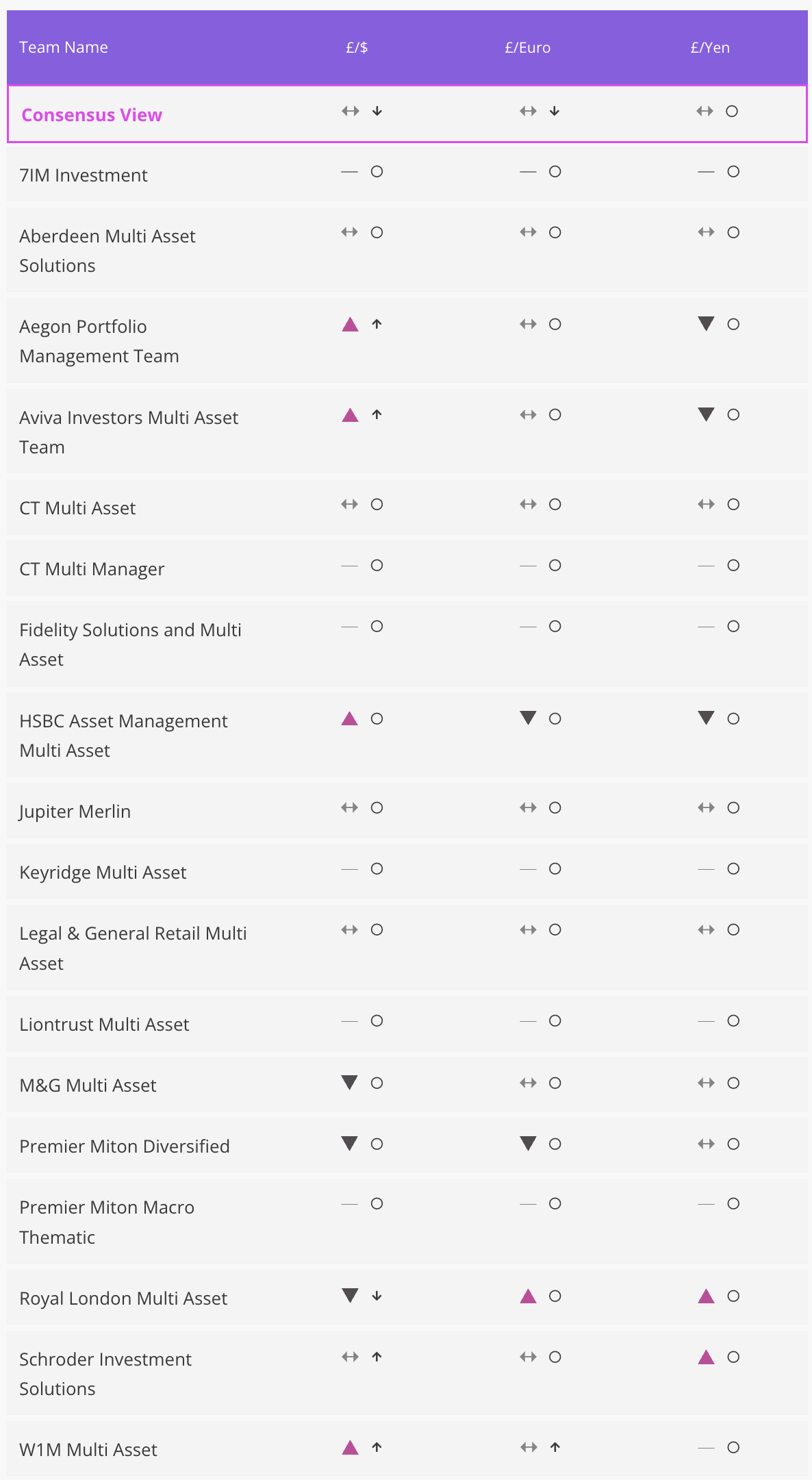
Our sentiment indicator shows the current direction of sentiment towards a broad range of asset classes as expressed by some of the UK’s leading multi asset teams. The first column for each asset class shows the multi asset teams’ current sentiments, and the second column shows how these have changed from the previous quarter. The tables below are updated quarterly.
Positive
The manager expects a positive return from the asset class over the next 12 month period.
Negative
The manager expects a negative return from the asset class over the next 12 month period.
Neutral
The manager is neither positive or negative about the prospects of the asset class over the next 12 month period.
No View
The manager currently has no view.
The manager has become more positive on the asset class since the last calendar quarter.
The manager has become more negative on the asset class since the last calendar quarter.
The manager’s view on the asset class hasn’t changed since the last calendar quarter.
For a guide to the symbols in the below table, please see the key.
For Q2 2026
Like the rest of us, multi asset managers have no visibility over the likely duration of the current events in the middle east – principally, but not exclusively, the blocking of the Straits of Hormuz and its ongoing adverse consequences for the price of oil and wider supply chains. This is making it difficult for them to make strong directional decisions on asset classes and regions – with many preferring to hover around neutral allocations whilst still leaning more towards risk assets overall – in particular, equities – where they believe the outlook remains relatively supportive.
In the meantime, having endured very low income yields for many years, credit markets appear to offer the prospect of modest total returns now that yields are higher – just so long as the inflation genie doesn’t escape from the bottle.
What is apparent, though, is that interest rates that had been predicted to fall this year are now likely to stay higher for longer – putting consumers under strain. In response, we now see some multi asset managers being prepared to include other commodities – either alongside of or instead of holding gold – in a bid to hedge against inflation.
Like its European counterparts, Japan is largely dependent upon importing its energy. But, having built up a very large strategic oil reserve, the impact of the events in the middle east on the Japanese economy is expected to be lower by comparison – at least for now. In the meantime, Japan’s oft cited corporate governance reforms, and the unwinding of company cross shareholdings, also continues to find favour with multi asset managers. Japanese companies’ earnings revisions remain supportive and overseas investors continue to benefit from a weak yen. In the meantime, while South Korean and Taiwanese equity markets are currently being dominated by a handful of high-flying technology companies, Japan’s equity market offers investors in the wider region a broader choice of companies across multiple industry sectors.
Multi asset managers continue to tell us that they still view larger UK companies positively – although it has to be said that we see little evidence of them increasing their allocations – in many cases quite the reverse. Nevertheless, larger rather than more domestically focused medium sized UK companies, get the nod – helped by attractive valuations and share buybacks.
Having pared back exposure to gold earlier this calendar year – and thereby, in some cases, locking in substantial profits – some multi asset teams have begun to edge back in. Some also express positive sentiment towards other commodity related such as energy, energy infrastructure and agriculture.
As we alluded to earlier, the turmoil in the middle east is having a negative impact upon many of Europe’s economies – with economic growth expected to remain sluggish and interest rates expected to rise to help dampen inflationary pressures.
In particular, despite still significant investor interest in defence, German industries continue to struggle. Setting aside the largest European economies like Germany and France, some multi asset managers continue to prefer Spain where economic growth remains more robust.
Sentiment towards US equities has nudged up slightly whilst still staying broadly in neutral territory this quarter. The US economy remains buoyant and is viewed as better equipped than most to withstand a global energy crisis given that it has its own resources. In the meantime, capital spending on building out AI continues to drive the technology sector, and earnings growth remains strong. However, we note that concerns over elevated valuations and concentration risk at the top of the main US equity index, is causing some multi asset managers to broaden out their exposure to other industry sectors, such as healthcare, energy, cyclicals, and smaller companies.
Although in relation to the US, Chinese equities appear to be more attractively priced, there appears to be little enthusiasm from multi asset managers to improve upon a neutral view overall – with many citing a preference for other Asian markets.
Without clarity as to the duration of the conflict in the middle east, or what its conclusion might eventually be, sentiment towards government bonds remains stuck in neutral – offering multi asset managers the ability to respond in whatever direction they deem to be beneficial once the current geopolitical mist clears. That said, we note a preference for short dated as opposed to longer dated government bonds owing to worries about inflation. In the meantime, they prefer UK gilts over other developed market government bonds now that their yields have risen.
More positivity versus the results of our last quarter’s sentiment indicator is in quite short supply.
We’ve already noted that sentiment towards US equities has improved slightly – partly this is in response to the earlier dip in the valuations of some of the big tech names, with some multi asset managers keen to add to their holdings at more attractive valuations.
We also note a slight uptick in sentiment towards investment grade bonds, although tight spreads relative to government bonds (the difference in the yield available from an investment grade bond when compared to the equivalent government bond with a similar duration profile) continues to keep the asset class at neutral.
The jump in energy prices caused by the blockage of the Straits of Hormuz has the potential to increase inflationary pressures within Europe’s energy-importing countries. This together with their generally weak economic performances is causing multi asset managers to dampen their sentiment towards the region.
Despite still heightened concerns about the level of US debt, the US dollar appears to have resumed its status as a safe haven asset in times of turmoil. Whether this will remain the case is not certain. But for now, the US dollar is seen as being a safer bet than the UK pound.
These comments reflect the interpretation by Scopic Research of the results from its latest quarterly multi asset teams’ sentiment indicator. They are in no way meant to confer investment advice. The information contained was correct at the time it was received, but investment sentiment can change rapidly – even on a one-year view. Past performance isn’t a guarantee of the returns that might be achieved in the future, and investment returns can be negative as well as positive. www.scopicresearch.co.uk